Work
Work is the force applied onto an object over a distance.
You can calculate the work done on an object by using the dot product:
Work = magnitude of a force F along d × magnitude of displacement
=∣ projdF ∣×∣ d ∣
=∣ d ∣∣ F ⋅ d ∣×∣ d ∣
=∣ F ⋅ d ∣
So, the work for a force F along a distance d is:
Work=∣ F ⋅ d ∣
Torque
Torque is a vector quantity, denoted as τ, is the measure of force applied about an axis in order to rotate an object.
Torque can be calculated using the cross product of the radius r from the object, and the force F applied:
∣ τ ∣=∣ r×F ∣=∣ r ∣∣ F ∣sinθ
Area of a parallelogram
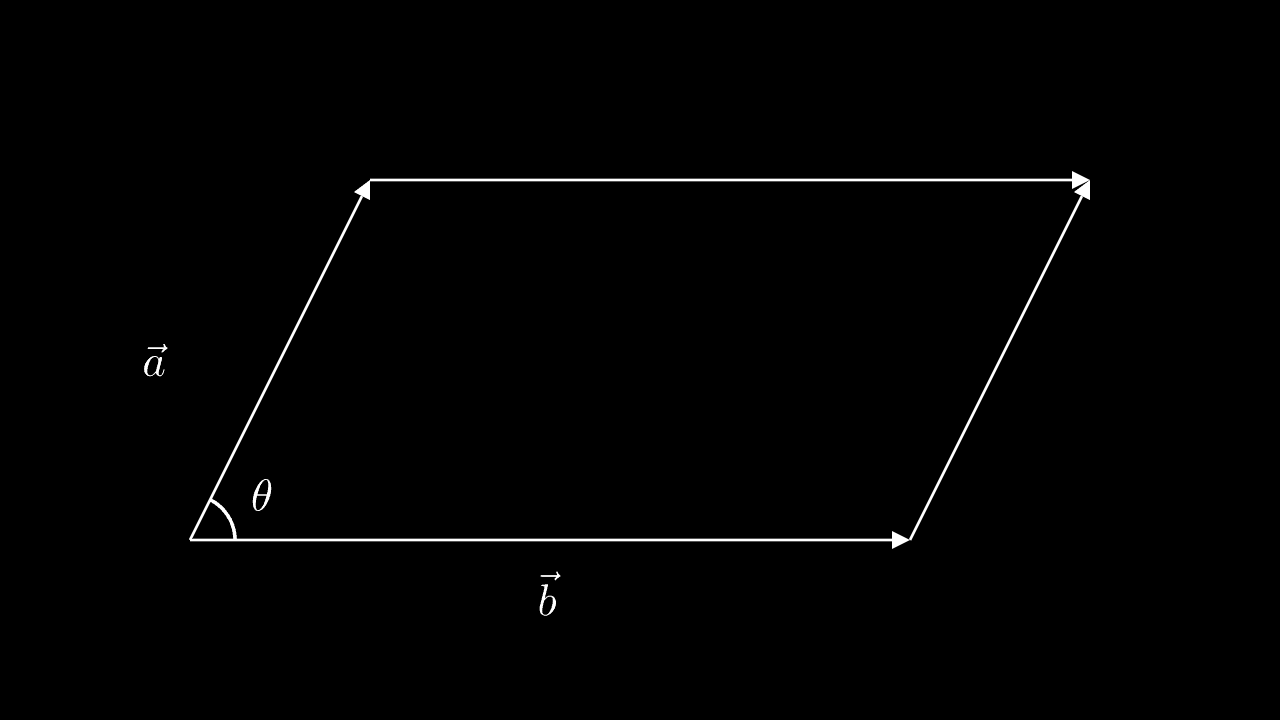
The area of a parallelogram formed by an upper vector a and a lower vector b is given by the magnitude of the cross product of both vectors:
A=∣ a×b ∣=∣ a ∣∣ b ∣sinθ
Volume of a parallelepiped
The volume of a parallelepiped formed by a vector c and two lower vectors a and b is given by the magnitude of the cross product of both vectors:
V=∣ a ⋅ (b×c) ∣