Types of intersections
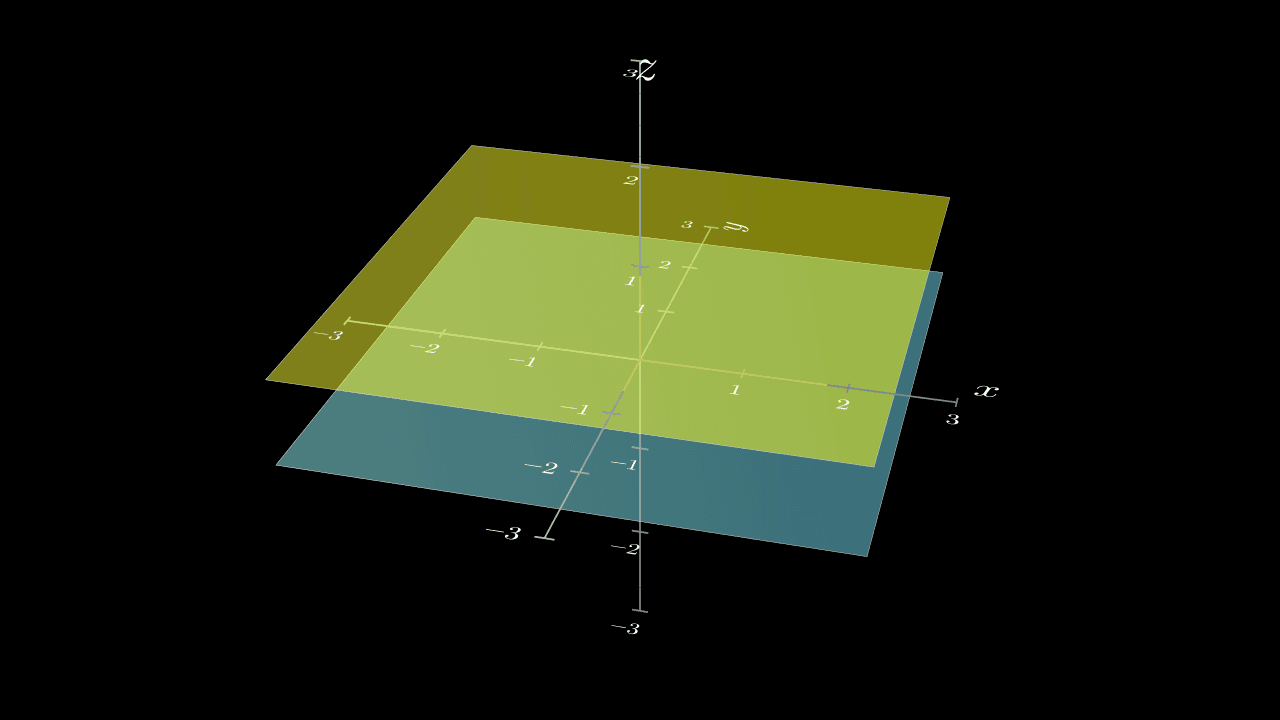 1. Planes are parallel
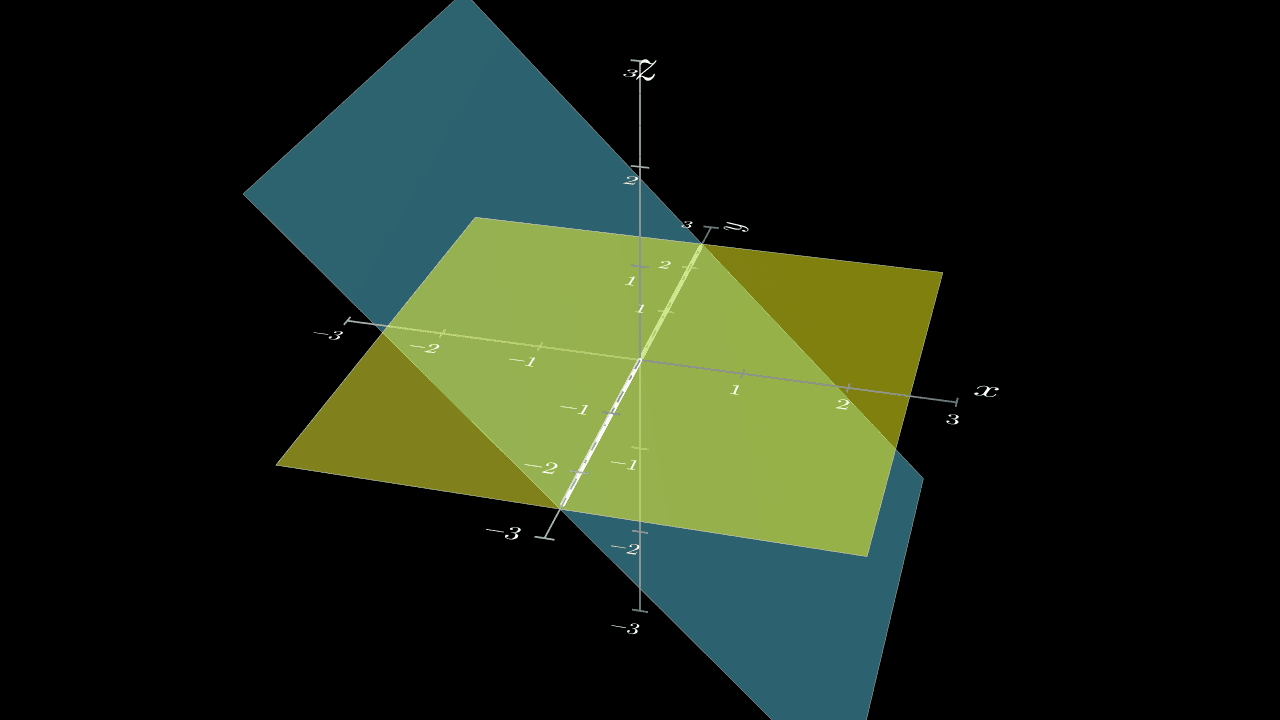 2. Planes intersect at a line
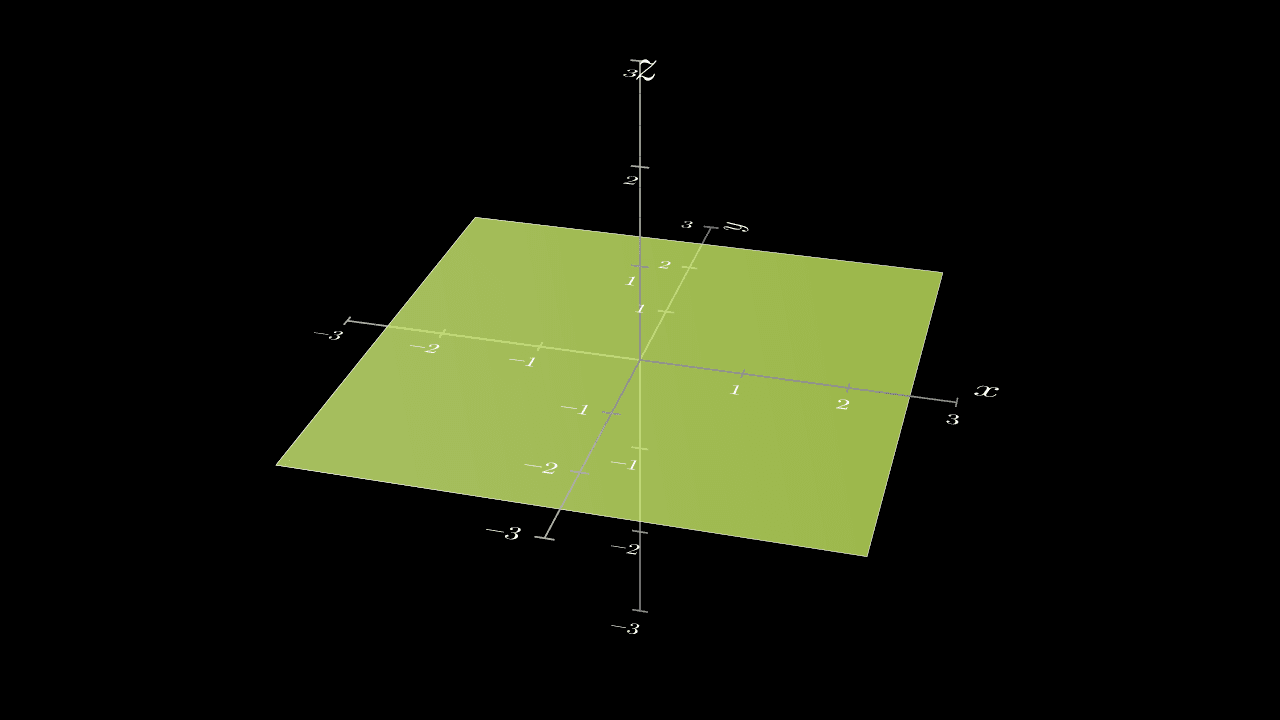 3. Plane contains plane
1. Planes are parallel
When two planes have the same normal, and do not share a common point, they are called parallel.
example
Find the points of intersection of the planes x+2y+z=4 and x+2y+z=5 if any exist.
answer
We can see if the planes are parallel by looking their normals:
n1=n2=(1, 2, 1) ⇒ Both planes are parallel to one another
Let's rearrange the equations:
x+2y+z=4 ⇒ x+2y+z−4=0
x+2y+z=5 ⇒ x+2y+z−5=0
Equating the equations, we get:
(x+2y+z−4)=(x+2y+z−5)
−4=−5
−4+5=0
1=0
Obviously 1=0, so there is no line that the planes intersect.
∴ The two planes are parallel.
2. Planes intersect at a line
When two planes are not parallel, they will share a line of intersection that contains an infinite number of points.
example
Find the points of intersection of the planes 3x+2y−z=1 and −x+2y+2z=2 if any exist.
answer
We can tell the planes are not parallel since their normals are not equal:
n1=(3, 2, −1)=(−1, 2, 2)=n2
This means they must intersect at a line
If we rearrange the values for z, we get:
3x+2y−z=1 ⇒ z=3x+2y−1
−x+2y+2z=2 ⇒ z=21x−y+1
If we equate them to each other, we get the equation of a line:
3x+2y−1=21x−y+1
6x+4y−2=x−2y+2
5x+6y−4=0
y=−65x+32
This is in fact the line of intersection of the planes!
∴ The planes intersect at the line y=−65x+32.
3. Plane contains plane
If one plane has the same or a multiple of the normal vector of another plane while also sharing a point, they contain each other.
example
Find the points of intersection of the planes 3x+3y+3z=12 and x+y+z=4 if any exist.
answer
As usual, we should first check if they are parallel:
n1=(3, 3, 3) and n2=(1, 1, 1) ⇒ n1=3n2
So, they are parallel.
Now, let's see if they share a line:
3x+3y+3z=12 ⇒ z=4−x−y for the first plane
x+y+z=4 ⇒ z=4−x−y for the second plane
As you can see, both planes are the same, which means they coincide.
∴ The planes are coincident.